

The Fitbit app officially dies this week.
Starting May 19, 2026, Google begins rolling out the Google Health app as a direct replacement for Fitbit. The transition completes by May 26. If you've been putting off dealing with this, don't worry. For most people, it'll happen automatically.
But there's more to this story than just a name change. Google is also killing off the Google Fit app later this year, and the new Google Health comes with a rebuilt AI coach that's now officially out of beta.
What's Actually Changing
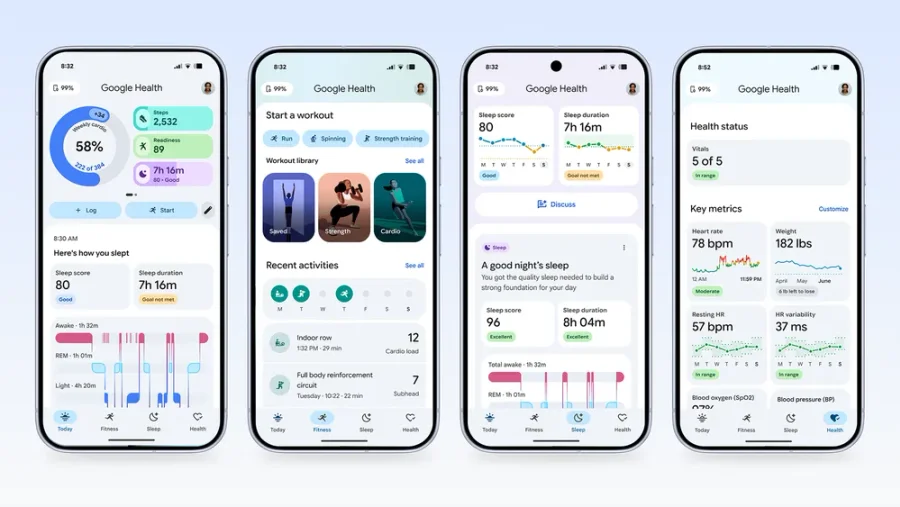
The Fitbit app you've been using since (probably) 2015 is getting a full makeover and a new name. Google Health keeps the same core tracking - steps, sleep, heart rate, workouts - but reorganizes everything around four tabs: Today, Fitness, Sleep, and Health.
The Today tab is your daily snapshot. You'll see your readiness score (how prepared your body is to handle the day based on sleep, recovery, and recent activity), your step count, cardio load, and a bunch of customizable tiles. Swipe right and you can add metrics like hydration, weight, food logging, and more. The log button at the bottom lets you manually enter data, snap photos of food, or upload files for the AI coach to digest.
The Fitness tab is where your workouts live. There's a workout library with guided sessions, activity tracking, and graphs showing cardio fitness, estimated VO2 max, running distance, and more. If you spring for Google Health Premium ($10/month or $100/year), this tab also hosts your personalized weekly fitness plan built with your coach.
Sleep and Health tabs do exactly what you'd expect. Sleep gives you sleep stages, scores, and trends, while Health shows your vitals (breathing rate, SpO2, HRV, skin temperature), lets you sync medical records, and set up alerts for irregular heart rhythms.
The AI Coach Is Finally Here
Fitbit's AI health coach has been floating around in public beta for a while, but the Google Health launch marks its official debut. The coach lives in a persistent "Ask Coach" button in the bottom right corner of every tab, and you can talk to it the same way you'd text a friend. Voice input supported, photos and file uploads supported, two-way conversation required.
It can answer questions about your sleep, help you build a marathon training plan, parse your medical records, or just explain what your readiness score actually means. Dave Dillon at Chase The Summit called the AI blurbs "wordy but insightful" in his first look at the app, and noted you can actually respond to them like talking to a real coach.
Here's the catch: deep access to the coach requires Google Health Premium. Basic features like the readiness score and sleep stages are free. But if you want the personalized workout plans, adaptive fitness guidance, and proactive insights, that's $10/month.
One nice surprise: Google Health Premium is included if you're already subscribed to Google One's AI Pro or AI Ultra plans. So if you're paying for Gemini access elsewhere, you might already have this.
Wait, Google Fit Is Being Sunsetted Too?
Yeah. The 12-year-old Google Fit app is getting merged into Google Health later this year. Google hasn't released migration details yet, but if you're one of the (probably small) group of people still using Google Fit, you'll need to move your data over eventually.
This is notable because Google Fit was a pretty bare-bones step and activity tracker. No sleep, no heart rate variability, no coach. If you were using it as a lighter-weight alternative to Fitbit, Google Health is essentially taking over that spot in the lineup.
Cross-Platform Flexibility
One thing that stands out: Google is leaning hard into cross-platform support. The new Google Health works with Health Connect on Android and Apple HealthKit on iOS. That's right. If you have an Apple Watch, you can pull that data into Google's ecosystem. Dave noted in his video that he already had Strava and Health Sync connected on his iPhone, and Apple Health was right there as an option too.
For a company that makes Android hardware, this is a weirdly generous move toward iOS users. But it makes sense. Google's health ambitions apparently extend beyond just selling Pixel Watches.
Also worth mentioning: the Fitbit Air ($99.99, ships May 26) was designed with this ecosystem in mind. Google's making noise about letting Fitbit Air data flow into Apple Health, though that feature won't be available at launch.
So Is This Good or Bad?
For existing Fitbit users, probably good. The app experience was already being overhauled. This is mostly just the branding catching up. You keep your data, you keep your tracking, and you get a shinier interface with an AI coach that might actually be useful.
For Google Fit holdouts: you've got a bit longer to figure out your next move, but the writing's on the wall.
For runners who bounce between platforms: the Apple Health integration is the most interesting part. Using an Apple Watch but jealous of Fitbit's sleep tracking and readiness score? Now you can have both, even if it takes some setup.
The app starts rolling out May 19. You've got a week before your Fitbit app transforms. Might be worth opening it up and taking a screenshot of any customizations or historical data you want to remember.


