


Four months. That's how long Stephen Curry has been wearing Google's new Fitbit screenless band in public before anyone officially acknowledged it exists.
If this is supposed to be a secret, it's the worst-kept one in wearables. But here's the thing: we don't think Google minds at all.
The Worst Kept Secret
The story starts back in January, when Curry - Google's official "Performance Advisor" - apparently started wearing the band during NBA games. He's worn it through a home stand in January, the All-Star game in February, and into March when he finally acknowledged the device in a sponsored post.
The NBA apparently prohibits players from wearing non-approved devices during games, which explains why Curry only takes it off during gameplay. But the rest of the time? The band's been front and center, just hidden in plain sight.
The first real acknowledgment came March 31, when Curry posted a video teasing "new Fitbit hardware." Since then, more images have surfaced showing the device in better detail than any official render could provide.
All the Images We've Found
From Steph Curry's Instagram
Curry's Instagram has become the de facto showcase for this device. The video teaser from March 31 showed the band clearly - a single wrapped design that's noticeably thinner than a Whoop Strap.
The band material looks nearly identical to Google's Pixel Watch Performance Loop Band - made of recycled polyester, nylon, and elastane yarns. It's a single lengthy strap that wraps around your wrist, through a metal loop, and attaches to itself.
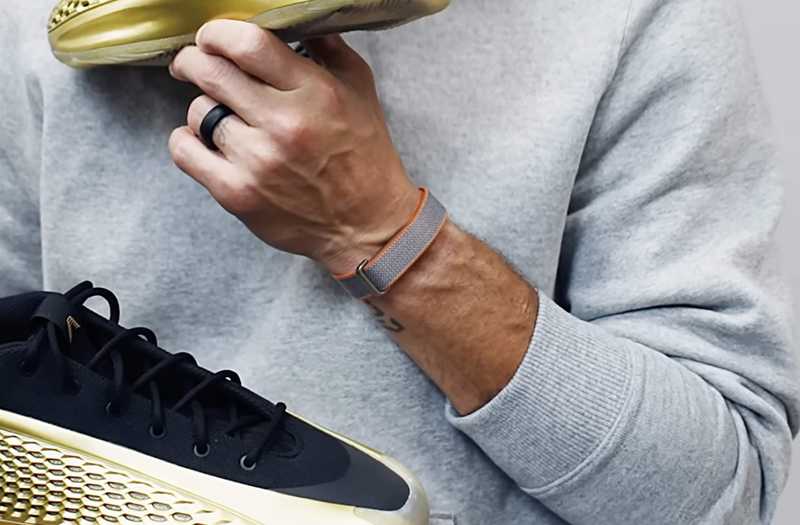 Credit: Stephen Curry / YouTube
View Curry's workout video here
From the Leaked Interface
 Credit: Droid Life / Source publication
This leaked screenshot shows the companion software - a Pixel phone displaying what appears to be Fitbit's tracking UI showing "Live data," cardio load, heart rate, energy burned, and elapsed time.
This is interesting because the current Fitbit app can't do this - it requires GPS for live tracking activities. A screenless band that pushes data to your phone makes sense, and this looks like the interface that would power it.
From Sotheby's Auction Video
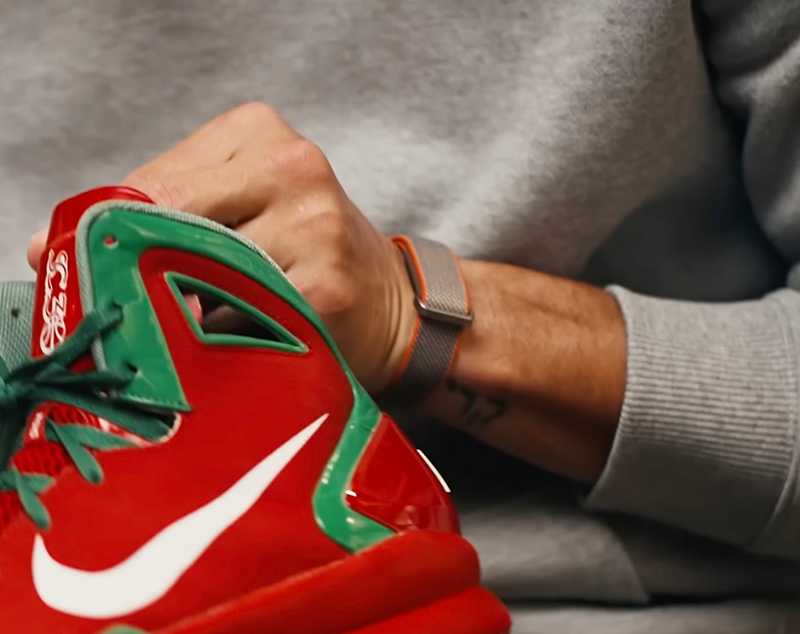
When Curry announced he was auctioning off sneakers he'd worn during his "sneaker free agency" period, Sotheby's posted a video showing the collection. Buried in that footage are 4K close-ups of the device on Curry's wrist that give us the clearest look yet.
The device is remarkably thin - significantly thinner than a Whoop MG according to people who've worn both. That's notable because thinness has been one of Whoop's weaknesses.
View Sotheby's video here (credit: Sotheby's / Stephen Curry)
From Getty Images / NBA Games
Getty photographers have captured Curry wearing the band during actual NBA games from January onwards. These show it during warm-ups against the Sacramento Kings on January 9, and throughout various appearances before the March announcement.
These aren't the clearest shots - NBA players are moving and the band is small - but they establish the timeline of when Curry started wearing it publicly.
View Curry warm-up photos on Getty Images - photographer: NBAE (credit: Getty Images / NBAE)
What We Think Is Happening
Here's our theory: Google is using Steph Curry as a walking billboard, and they're totally fine with everyone knowing it.
Curry has been Google's "Performance Advisor" for a while now. Having the most recognizable basketball player on the planet wear your unreleased product in public isn't an accident - it's marketing.
The fact that the band has been visible for four months without Google sending lawyers suggests they're completely comfortable with this. When you control the revealer, you control the narrative. Everyone knows it's coming, everyone talks about it, and when Google officially announces it, the buzz is already built.
This is a sophisticated marketing play. Instead of Apple-style complete secrecy until announcement, Google is using Curry's public appearances as organic marketing. Every time Curry wears it in a visible moment, people notice and talk about it.
For a company that makes most of its money from advertising, Google understands how awareness works better than most.
What We Know About the Device
From the images, here's what we can see:
Design: Single wrap-around band with a metal clasp/loop. Thinner than Whoop. Available at least in a light gray/silver color.
Material: Same Performance Loop-style construction as Google's existing bands - recycled polyester, nylon, and elastane.
Software: Appears to use Fitbit's existing tracking UI with "Live data" streaming to a phone. No screen on the device means all interaction happens through the phone app.
Battery: Unknown, but screenless bands typically last 3-7 days.
Subscription: Given Fitbit's history and the fact that Google needs to compete with Whoop's $149/year model, expect a Premium tier for advanced features.
The Timeline So Far
January 2026: Curry first spotted wearing the device during NBA games
January 9: Photographed during warm-ups vs Sacramento Kings
February: Seen wearing it at NBA All-Star weekend
March 31: Curry posts official teaser video acknowledging the device
April 15-16: Multiple outlets compile all available images and details
Why This Matters for Runners
Runners have been watching the Whoop vs Garmin vs Fitbit space with interest. Whoop dominates in certain circles because it delivers what serious athletes want: tracking without distraction.
Garmin has its ecosystem locked up for training metrics. Fitbit has the broader health tracking and the Google integration. A Fitbit screenless band would give Google a product specifically targeting the Whoop crowd - athletes who want data without the smartwatch interface.
The appeal of a screenless band for runners is real. During daily life, you don't need pace, distance, and GPS. You need heart rate variability, sleep quality, and recovery status. A band that passively tracks those metrics without looking like a fitness tracker is genuinely useful.
Whoop understood this. The band became popular not despite being screenless but because of it. Runners and athletes stopped wanting their watch to be a second phone and started wanting it to be a wellness tracker that stayed out of the way. Google clearly noticed.
Is This a Whoop Killer?
That's the million-dollar question. Whoop built its entire business on the "screenless band for athletes" concept, and it works. Serious runners, CrossFit athletes, and pro sports teams use Whoop because it tracks everything without being distracting.
If Google can deliver comparable tracking with Fitbit's ecosystem and integration - plus Curry's endorsement and Google's resources - it could be a real alternative.
The fact that this has been "secret" for four months while being worn by one of the world's most photographed athletes is either hilarious or brilliant, depending on how you look at it.
For more on what we know about Google's Fitbit plans, check out our earlier coverage of the Whoop competitor rumor.
Image credits: Stephen Curry (Instagram, YouTube), Sotheby's (auction video), Getty Images / NBAE (game photos), Droid Life (interface screenshot). All rights belong to respective owners.


